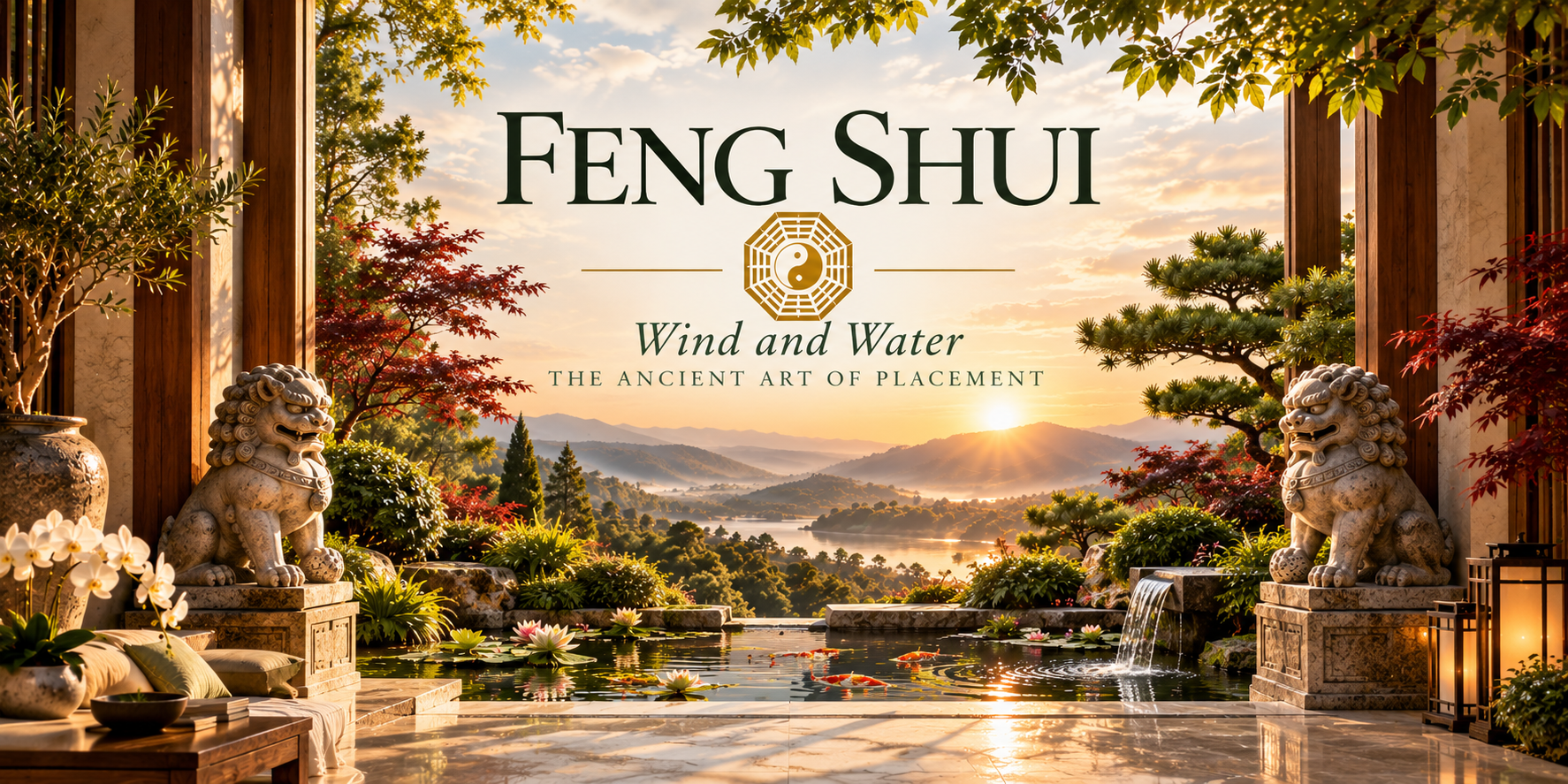
What Is Feng Shui?
Feng Shui is an ancient Chinese system for understanding the relationship between people, place, energy, and the natural world.
The words Feng Shui translate as “wind” and “water.” Wind represents movement and the unseen flow of energy, while water is associated with gathering, nourishment, and flow.
Although Feng Shui is often called the art of placement, it is much more than deciding where to put a bed, desk, mirror, or piece of furniture.
At its heart, Feng Shui examines the relationship between you and your environment—and how the spaces surrounding you can support the way you want to live.
CHI — The Energy of a Space
This would work beautifully as a full-width atmospheric photograph with a smaller text box over one side.
Understanding Chi
One of the foundational concepts of Feng Shui is Chi (Qi)—the vital energy or life force that flows through all things.
In nature, we experience Chi in moving water, wind through trees, sunlight, plants, changing seasons, and living landscapes.
Within our homes, Chi moves through entrances, rooms, hallways, windows and open spaces.
The goal is neither rushing energy nor stagnant energy, but a balanced, nourishing flow that supports the people living within the space.
Yin & Yang — The Art of Balance
Feng Shui recognizes that life exists through complementary forces.
YIN
Quiet • Rest • Softness • Darkness • Receptivity
YANG
Activity • Light • Movement • Sound • Expression
Neither is better than the other. Feng Shui asks us to create the appropriate balance for the purpose of a space.
A bedroom needs qualities that encourage restoration and rest. A kitchen or active workspace naturally requires more Yang energy..
The Five Elements
WOOD • FIRE • EARTH • METAL • WATER
The Five Elements describe different expressions of energy found throughout nature and within our environments.
Wood — Growth • Vitality • Expansion
Fire — Illumination • Passion • Activity
Earth — Grounding • Stability • Nourishment
Metal — Clarity • Structure • Refinement
Water — Flow • Depth • Intuition
We can introduce these energies into our environments through color, shape, materials, artwork, furnishings, plants, lighting and architectural features.
The Bagua — A Map of Life
The Bagua is one of the tools used in Feng Shui to explore how different areas of an environment correspond symbolically with different aspects of our lives.
Depending upon the Feng Shui tradition being practiced, the Bagua may be applied in different ways.
Rather than seeing it simply as a decorating formula, I like to think of the Bagua as a tool for awareness.
What is this space communicating—and does it support where I am going?
The Importance of Placement
Where we sleep, work, cook, gather and enter our homes can influence how supported and comfortable we feel within an environment.
One important Feng Shui principle is the command position—placing ourselves where we have a strong relationship to the entrance while also having support behind us.
This principle is particularly important when positioning beds and desks.
Good placement isn't simply about following a rule. It is about creating an environment where the body can settle and the person occupying the space can feel supported.
The Landscape Comes First
Feng Shui did not begin as an interior decorating practice.
Its earliest principles were deeply connected to land, mountains, waterways, orientation, climate, and the movement of natural forces across the landscape.
Before considering what is inside a home, traditional Feng Shui looks at what surrounds it.
Roads, neighboring structures, trees, hills, waterways, the approach to the property and the relationship between the building and its site all contribute to the experience of a place.
The house and the land belong to the same energetic system.
Feng Shui Is Personal
There is no single perfect Feng Shui home.
The environment must ultimately support the people who live there.
Our stage of life, relationships, work, aspirations, personal energy and response to our surroundings all influence what feels supportive.
This is where Feng Shui moves beyond rules and becomes a practice of observation, awareness and intention.
Renae Jensen
Feng Shui Teacher & Consultant
Over 20 years of teaching, consulting and exploring the relationship between people and place.
From Feng Shui to Alignment
After more than twenty years of teaching and practicing Feng Shui, I have come to see its deeper lesson very simply:
Everything is connected.
We affect our environments, and our environments affect us.
When our surroundings, intentions, actions and inner lives begin moving in the same direction, something changes. There is less resistance and greater flow.
For me, this is where the ancient wisdom of Feng Shui naturally meets Align and Receive.
Feng Shui begins with the space around us.
Alignment asks us to bring that same awareness within.